
Reusable Mushroom Head Interlocking Fasteners for Craft Displays
Oct 27, 2026
The Complete Guide to Reusable Mushroom Head Interlocking Fasteners for Handcraft Exhibitions
Introduction
Organizing a school art exhibition, community craft fair, or temporary creative display involves more than arranging artwork. You also need a reliable way to secure decorations, posters, lightweight display panels, and handmade pieces without compromising their appearance.
Traditional fastening methods can present challenges. Some adhesive tapes may leave residue or damage delicate paper when removed. Metal clips can create pressure marks or tear thin materials, while permanent adhesives may make repositioning and reuse difficult.
Reusable mushroom head interlocking fasteners offer another option. Their specially shaped interlocking heads engage when pressed together and separate when sufficient peeling force is applied. Depending on the product design, they can provide a convenient way to attach and remove compatible display components.
For organizers working with limited budgets, the key is to choose a fastening solution that matches the material, weight, mounting surface, and expected frequency of use. A product designed for heavy-duty industrial applications may not be the most appropriate choice for lightweight artwork.
In this guide, we explain how to evaluate mushroom head interlocking fasteners, select suitable configurations for different craft materials, install them carefully, and maintain them for repeated use.
E-HOOK, a product brand of Dongguan Jiehuan Electronic Technology Co., Ltd., offers fastening solutions for different application requirements. Understanding the differences between product structures, backing materials, and fastening methods can help buyers make more informed decisions for craft displays and other light-duty applications.
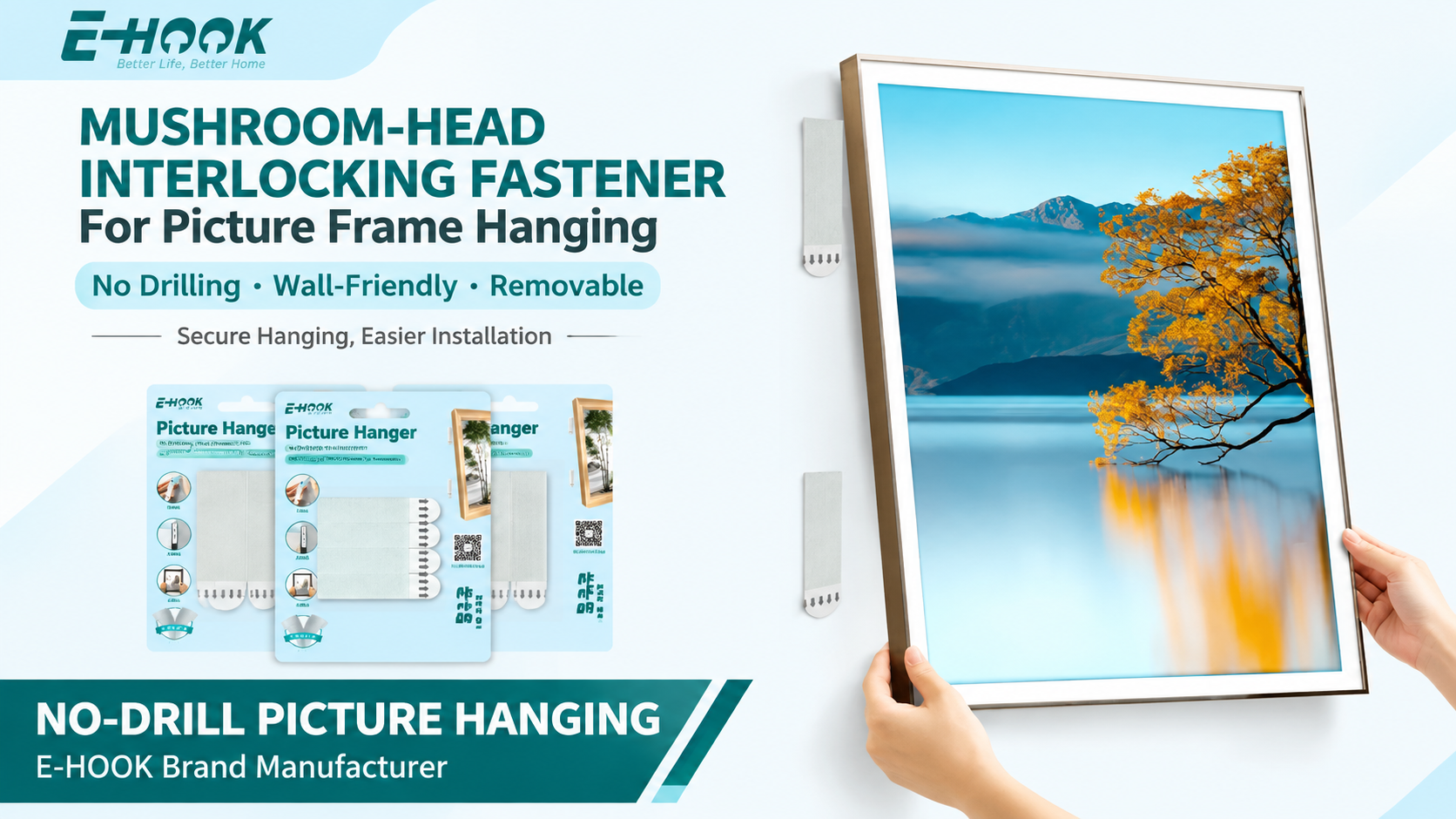
1. Understanding Mushroom Head Interlocking Fasteners
Mushroom head interlocking fasteners use small, mushroom-shaped protrusions that engage with one another to create a mechanical connection. Unlike conventional hook and loop fasteners, which rely on hooks catching flexible loops, mushroom head systems use specially shaped heads to form an interlocking structure.
The actual holding performance depends on several factors, including head geometry, engagement density, material properties, fastening area, adhesive selection, and the surface to which the fastener is attached.
These products are available in different configurations, including adhesive-backed strips, non-adhesive components, fabric-integrated solutions, and other application-specific designs.
When evaluating a product for an exhibition, consider the complete fastening system rather than focusing on the interlocking material alone.
Key factors to evaluate:
- Holding performance: Can the fastener support the intended load under the expected conditions?
- Surface compatibility: Is the adhesive or mounting method suitable for the display surface?
- Ease of removal: Can the components be separated without applying excessive force to the artwork?
- Reusability: Can the interlocking surfaces maintain acceptable performance after repeated engagement and separation?
- Environmental conditions: Will dust, moisture, temperature changes, or outdoor exposure affect performance?
- Application requirements: Does the product need to be concealed, repositioned, cut to size, or removed after the event?
2. How to Choose Fasteners for Different Craft Materials
Not every fastening solution is suitable for every material. Before purchasing mushroom head interlocking fasteners, identify the material of the artwork, the intended mounting position, and whether the fastener will contact the finished surface directly.
The following recommendations are starting points for evaluation, not universal guarantees. Always test the actual product on a representative sample before applying it to valuable or delicate artwork.
Paper, Posters, and Cardstock
Paper-based artwork can be vulnerable to adhesive residue, surface coating damage, and tearing during removal.
For posters, drawings, and cardstock displays, consider a mounting arrangement that places the fastening material on the back of a supporting board or display frame rather than directly on the artwork.
If adhesive-backed fasteners are necessary, check the adhesive specifications and test the complete assembly on a spare piece of the same paper. Even products described as low-tack or removable may damage certain coatings, inks, or paper fibers.
Fabric, Embroidery, and Woven Artwork
Textile projects can snag when exposed to unsuitable fastening structures. Loose threads, delicate embroidery, and knitted materials require particular care.
Where possible, attach the fastening component to a backing panel, fabric tab, or dedicated mounting area instead of pressing it directly against decorative stitching.
For textile-integrated fastening solutions, check the bonding method, flexibility, and compatibility with the fabric. Avoid assuming that every mushroom head structure is suitable for direct contact with knitted or loosely woven surfaces.
Clay, Painted Plaster, and Decorative Objects
Clay ornaments, painted plaster, and other rigid decorative pieces may be vulnerable to surface scratching, paint lifting, or breakage under concentrated force.
For these applications, consider attaching the fastener to a supporting base, display stand, or separate mounting component rather than directly to the finished artwork.
Before using an adhesive-backed product, verify that the adhesive is compatible with the coating and substrate. For valuable pieces, a removable mechanical support may be a better choice than direct adhesive attachment.
Wood, Acrylic, and Display Frames
Rigid materials such as wood and acrylic can offer more practical mounting surfaces, but surface finish, cleanliness, and adhesive compatibility still matter.
For frames and display panels, choose a fastening configuration according to the load, contact area, mounting orientation, and frequency of removal.
For larger or heavier displays, do not rely on a small fastening area without checking the manufacturer's load data and testing the complete assembly.
3. Step-by-Step Installation and Removal Guide
Step 1: Assess the Artwork and Mounting Surface
Start by identifying the weight, dimensions, material, and center of gravity of the item you want to display. Check whether the mounting surface is smooth, textured, painted, coated, or fabric-covered.
Determine whether the fastener will be attached directly to the artwork or to a separate backing structure. Whenever possible, use the backing structure to reduce the risk of damaging the finished surface.
Step 2: Select the Appropriate Fastener Configuration
Choose the fastening configuration according to the application.
- Adhesive-backed fasteners may be suitable for compatible, clean, and stable surfaces.
- Non-adhesive components may be useful when incorporated into a separate mechanical mounting arrangement.
- Fabric-integrated fastening options may be appropriate for compatible textile assemblies.
- Straps or adjustable mounting components may be worth considering when the artwork should not be bonded directly to a surface.
For products marketed using the term “dual lock,” confirm the exact product construction and intended application. Similar terminology does not guarantee identical fastening performance or compatibility.
Step 3: Prepare and Position the Components
Clean the mounting surface using a method suitable for the material, and allow it to dry completely before applying an adhesive-backed fastener. Follow the product manufacturer's preparation instructions.
Measure the intended fastening area and position the components carefully. Keep the fastener away from painted details, printed text, delicate edges, and other areas that could be damaged during removal.
If cutting is permitted by the manufacturer's instructions, use clean tools and avoid leaving sharp or uneven edges.
Step 4: Engage the Interlocking Heads
Align the two fastening components and press them together according to the manufacturer's instructions. Ensure that the intended engagement area is properly connected before placing the display under load.
Do not assume that a stronger press always produces a better result. Excessive pressure may damage fragile artwork, deform a supporting material, or affect the adhesive bond.
For valuable pieces, test the fastening arrangement with a lightweight sample before proceeding with the actual exhibition setup.
Step 5: Test Stability Before the Exhibition
After installation, check whether the display remains stable in its intended orientation. Pay attention to peeling forces, sideways movement, uneven loading, and any movement caused by visitors or environmental conditions.
For overhead displays, heavy panels, or installations where failure could injure someone, use an appropriately rated mounting system and suitable secondary support where necessary.
Do not rely on a generic load estimate when the actual product specification or mounting conditions differ.
Step 6: Remove Carefully and Store for Reuse
When the exhibition ends, support the artwork before separating the fastener. Follow the manufacturer's recommended release method and avoid sudden pulling that could damage the mounting surface.
Where the product design permits peeling separation, gradual separation may help reduce abrupt force transfer. However, the appropriate technique depends on the product and the materials involved.
After removal, inspect the interlocking surfaces for dust, damage, or deformation. Clean and store the components according to the manufacturer's care instructions. Adhesive-backed products may not retain their original bonding performance after removal, even if the interlocking surfaces remain functional.
4. Five Fastening Solutions to Consider for Craft Displays
Different display projects require different mounting methods. Rather than assuming that one fastener works for every material, compare the available configurations against your specific requirements.
1. Adhesive-Backed Mushroom Head Interlocking Fasteners
These may be suitable for compatible display boards, frames, and other stable mounting surfaces. Before applying them to paper or painted objects, test the adhesive on a representative sample and verify its removal characteristics.
2. Fabric-Compatible Fastening Components
For textile displays, consider a fastening component designed to work with the relevant fabric or supporting structure. Check whether the attachment method could snag threads or distort delicate stitching.
3. Non-Adhesive Interlocking Components
Non-adhesive components may be useful when the fastener can be incorporated into a mechanical holder, backing panel, or other mounting assembly. This approach can help avoid applying adhesive directly to the artwork.
4. Adjustable Straps and Mounting Accessories
Straps and adjustable components can help secure selected display items without bonding the fastening material directly to the finished surface. Confirm that the strap and connection points are suitable for the load and display orientation.
5. Temporary DIY Mounting Arrangements
For short-term, lightweight displays, a simple removable mounting arrangement may be sufficient. However, improvised combinations of fastening material and household adhesive can have unpredictable strength, leave residue, or damage the display surface.
For important artwork or any installation that requires reliable load support, choose a properly specified fastening solution instead of relying on an untested DIY assembly.
5. How to Evaluate a Mushroom Head Interlocking Fastener Supplier
Choosing the right supplier is as important as selecting the right fastening structure. For schools, craft retailers, event organizers, and small businesses, a practical evaluation should cover product suitability, quality documentation, order flexibility, and communication.
Product specifications
Ask for the product's dimensions, material information, available backing options, recommended applications, and relevant load-performance data. Confirm that the specifications apply to the exact product configuration you intend to purchase.
Quality and compliance documentation
If a supplier claims ISO 9001 certification, third-party testing, or compliance with environmental regulations, request the relevant documents. Check the issuing organization, validity period, covered products or facilities, and applicable test conditions.
A certification for a management system should not automatically be interpreted as certification of every individual product.
Sample availability
Samples allow buyers to evaluate engagement, separation, adhesive compatibility, surface appearance, and installation convenience before placing a larger order.
For delicate artwork, sample testing is especially important because performance can vary considerably between substrates and surface finishes.
Order quantities and customization
Small exhibitions may require only a limited number of fasteners, while distributors and commercial buyers may need larger quantities or customized dimensions. Ask whether the supplier supports sample orders, small batches, repeat purchases, and application-specific customization.
Technical communication
A capable supplier should be able to explain product differences, clarify limitations, and help identify the relevant configuration. Clear communication is particularly valuable when the intended application falls outside standard industrial fastening scenarios.
6. E-HOOK: Fastening Solutions for Different Applications
E-HOOK is a product brand of Dongguan Jiehuan Electronic Technology Co., Ltd., a manufacturer of fastening products serving different application requirements.
When sourcing mushroom head interlocking fasteners, buyers should consider more than the basic product name. The appropriate configuration depends on the intended load, mounting surface, required fastening area, removal method, and expected service conditions.
E-HOOK's broader fastening product range includes solutions such as adhesive-backed hook and loop products, back-to-back hook and loop fasteners, PUR hot-pressed products, fastening straps, and injection-molded fastening components.
These product categories serve different purposes and should not be treated as interchangeable. Buyers can discuss their application requirements with the supplier to identify the most appropriate product structure.
For craft exhibitions and display projects, useful information to provide during a product inquiry includes:
- The material and approximate weight of the item.
- The surface where the fastener will be installed.
- Whether direct adhesive contact with the artwork is acceptable.
- The required fastening dimensions and mounting orientation.
- Whether the components need to be removed or reused.
- The expected order quantity and any customization requirements.
Providing these details helps the supplier evaluate the application more accurately and recommend a suitable starting point for sample testing.
For distributors, retailers, and other B2B buyers, E-HOOK can also be considered when comparing product configurations, discussing customized fastening requirements, and planning repeat sourcing.
7. Frequently Asked Questions
Q1: Can mushroom head interlocking fasteners be reused?
Many mushroom head interlocking fasteners are designed for repeated engagement and separation. However, their usable life depends on the product construction, operating conditions, contamination, wear, and any adhesive used for mounting.
Ask the manufacturer for applicable reuse-cycle data and the conditions under which the data was measured. Do not assume that every product supports the same number of cycles.
Q2: Will mushroom head interlocking fasteners damage paper or artwork?
They may, depending on the adhesive, paper type, surface coating, fastening area, and removal technique. The interlocking mechanism itself does not guarantee damage-free removal.
Whenever possible, attach the fastener to a backing board or separate mounting component. If direct attachment is necessary, test the exact product on a spare piece of the same material before use.
Q3: Are mushroom head interlocking fasteners the same as dual lock fasteners?
The terms may be used to describe similar types of interlocking fastening mechanisms, but they do not automatically refer to identical products. Product structure, materials, performance, and compatibility can differ between manufacturers.
When purchasing, verify the actual product specifications rather than relying on terminology alone. E-HOOK buyers should confirm the exact configuration and intended application with the supplier.
Q4: Can these fasteners be used on clay, painted surfaces, or delicate fabrics?
Some configurations may be suitable for these applications, but direct attachment requires careful evaluation. Adhesives may affect coatings, while mechanical engagement or removal forces may damage delicate materials.
Consider a separate mounting support and test the complete assembly before using it on finished artwork.
Q5: How do I determine the correct fastening size?
Start with the item's weight, the intended mounting orientation, the number and location of fastening points, and the manufacturer's load-performance data.
Do not select the fastening area based only on the item's weight. Peeling forces, uneven loading, surface condition, and the strength of the mounting substrate can all affect the result.
For heavier or safety-critical displays, obtain product-specific technical guidance and use an appropriately designed mounting system.
Q6: What should I ask a supplier before placing an order?
Request the product specifications, available materials and backing options, relevant test reports, recommended applications, sample availability, minimum order quantity, and customization options.
If the product will be used on delicate artwork, explain the substrate and removal requirements clearly. This helps the supplier determine whether the proposed product is appropriate for the intended use.
Conclusion
Choosing mushroom head interlocking fasteners for a handcraft exhibition is not simply a matter of finding the strongest fastening material. The right solution must balance holding performance, surface compatibility, ease of installation, removal requirements, and the possibility of repeated use.
Before purchasing, identify the materials involved, determine how the artwork will be supported, review the manufacturer's specifications, and test the complete fastening arrangement. For fragile paper, textiles, painted objects, and other delicate materials, a separate backing structure may be safer than direct adhesive attachment.
For organizers, retailers, distributors, and other buyers looking for fastening solutions, E-HOOK offers a starting point for exploring different product configurations and discussing application-specific requirements.
Whether you are preparing a small school exhibition or sourcing fastening products for a wider range of projects, careful product selection and practical testing can help you build a more reliable display system while reducing the risk of avoidable damage.