
2026 Step-by-Step R&D Guide: Locate the Right Self-Mating Mushroom Fastener
Oct 28, 2026
2026 Step-by-Step R&D Selection Guide: How to Quickly Find the Right Plastic Self-Mating Mushroom Fastener
Introduction
For industrial design engineers, product R&D specialists, and procurement coordinators, selecting the right plastic self-mating mushroom fastener can be more complicated than it seems. Scattered product listings, inconsistent specifications, limited technical documentation, and repeated sample testing can all slow down new product development.
When sourcing dual lock fasteners or mushroom-head interlocking fasteners, teams need more than a product name. They need reliable dimensional data, clearly defined performance requirements, compatible materials, and practical guidance on customization.
This step-by-step guide explains how to evaluate plastic self-mating mushroom fasteners, compare key technical parameters, identify suitable options for different industrial applications, and work with suppliers on non-standard requirements. Whether you are searching for dual lock fasteners for a new product design or refining an existing fastening solution, a structured selection process can help reduce unnecessary sampling and improve development efficiency.
1. Pre-Selection Parameter Analysis for Plastic Self-Mating Mushroom Fasteners
1.1 Structural Principles and Material Properties
Plastic self-mating mushroom fasteners feature mushroom-shaped protrusions on both mating surfaces. When pressed together, these protrusions interlock to create a reusable fastening connection without requiring separate hook and loop layers.
This structure makes mushroom-head interlocking fasteners worth considering for applications that require repeated attachment and removal, compact construction, or a clean fastening appearance. Depending on the product design, they may be used in equipment panels, consumer products, interior components, and other assemblies.
When comparing dual lock fasteners and other reclosable interlocking solutions, do not rely on terminology alone. Different products can vary significantly in stem geometry, engagement density, material composition, opening force, tensile performance, and adhesive backing. Always review the supplier's actual specifications and test conditions before making a selection.
Common engineering plastics to evaluate include nylon, polypropylene (PP), and polyoxymethylene (POM). Their suitability depends on operating temperature, mechanical loading, chemical exposure, environmental conditions, and the required service life.
| Material | General characteristics | Selection considerations |
|---|---|---|
| Nylon | Good mechanical strength and toughness | Evaluate moisture absorption and temperature-related dimensional changes |
| PP | Lightweight with good resistance to many chemicals | Consider stiffness, temperature limits, and long-term loading |
| POM | Good dimensional stability and wear resistance | Verify compatibility with the specific chemicals and operating environment |
1.2 Key Performance Data to Verify
Before approving any self-mating mushroom fastener for production, request technical documentation that clearly defines the testing method, sample configuration, environmental conditions, and acceptance criteria.
For example, tensile retention after aging, chemical resistance, operating temperature, and repeated engagement performance should be assessed using methods appropriate to the intended application. If a supplier provides third-party test reports, confirm that the reports correspond to the exact product model and material formulation being considered.
Environmental compliance also deserves attention. Depending on the target market and end use, buyers may need documentation relating to RoHS, REACH, or other applicable requirements. Do not assume that every material grade or finished product is automatically covered by a general supplier declaration.
For adhesive-backed dual lock-style fastening solutions, evaluate the adhesive separately from the interlocking structure. Substrate compatibility, surface cleanliness, temperature, humidity, and applied pressure can all affect bond performance. A product that performs well mechanically may still be unsuitable if its adhesive cannot meet the installation requirements.
2. A Five-Step Parameter Checklist for R&D Projects
A structured selection process helps translate general product requirements into measurable specifications. Before comparing dual lock fasteners or requesting samples, work through the following five steps.
Step 1: Define the engagement geometry and installation space
Measure the available fastening area, cavity dimensions, and installation clearance on both mating components. Record the required engagement depth, dimensional limits, and any restrictions imposed by adjacent parts.
Include manufacturing tolerances in the design review. A suitable tolerance allowance should be determined from the actual component drawings, manufacturing process, and supplier specifications rather than applying one universal value to every project.
Step 2: Establish the required holding force
Determine the maximum expected load during normal use, including relevant pulling, peeling, shear, and dynamic forces. Define the required safety margin based on the consequences of accidental release, the frequency of loading, and the operating environment.
Do not compare holding-force values unless the test direction, engagement area, sample preparation, and testing procedure are comparable.
Step 3: Check substrate and panel compatibility
Confirm the thickness, rigidity, surface finish, and dimensional variation of the components to be joined. Flexible panels may deform under concentrated loads, while uneven or low-energy surfaces may require a different adhesive or mounting method.
Step 4: Identify operating conditions
Document relevant conditions such as temperature fluctuations, vibration, UV exposure, moisture, chemical contact, and the expected number of opening and closing cycles.
For high-vibration applications, request test evidence that reflects the actual assembly and operating conditions. A product's general mechanical rating alone does not establish suitability for every vibration environment.
Step 5: Confirm regulatory and documentation requirements
Identify the standards and material declarations required for the destination market and end product. Depending on the application, these may include environmental compliance documentation, automotive requirements, flame-retardancy testing, or food-contact requirements.
3. Matching Mushroom-Head Fasteners to Industrial Applications
Once the core parameters have been defined, narrow down the options according to the actual application. The following scenarios illustrate the factors that R&D and procurement teams should prioritize when evaluating self-mating mushroom fasteners.
Automotive interior components
Prioritize dimensional stability, temperature performance, vibration resistance, and compatibility with interior substrates. Check the applicable automotive specifications and low-emission requirements for the finished assembly.
Do not select a material based on a general temperature range alone. Verify the fastener's performance under the specific temperature cycles and loading conditions expected in the vehicle.
Consumer electronics housings
Low-profile fastening structures may help save installation space in compact devices. Compare engagement depth, overall thickness, component weight, and ease of service access.
For applications involving frequent maintenance, assess how repeated engagement affects holding force and the condition of the mating surfaces.
Home decoration and removable panels
For decorative panels and household installations, consider appearance, ease of removal, noise during disengagement, and the possibility of damaging the substrate.
The right solution depends on panel weight, mounting orientation, surface finish, and the intended removal frequency. Test the complete installation rather than relying solely on the fastener's standalone specifications.
Industrial equipment panels
For equipment covers and service panels, focus on holding force, vibration performance, durability, and maintenance requirements. Confirm that the selected fastening structure remains secure under the expected operating loads while still allowing authorized personnel to remove the panel when needed.
When evaluating dual lock mushroom fasteners for industrial equipment, request application-specific test results and verify the complete assembly before production approval.
4. Building a Practical Cross-Reference Parameter Table
A structured comparison sheet makes it easier to shortlist suitable products without repeatedly reviewing scattered supplier listings. For each candidate, record the following information:
- Supplier model number and product type
- Mushroom-head geometry and engagement dimensions
- Overall thickness and installation clearance
- Static tensile, shear, and peel performance, where applicable
- Opening force and repeated engagement performance
- Base material and operating temperature limits
- Adhesive type and substrate compatibility, if adhesive-backed
- Relevant test reports and compliance documentation
- Available sample quantity, lead time, and customization options
The table below illustrates a simple comparison format. The values should be populated using actual supplier datasheets and verified test reports.
| Parameter | Candidate A | Candidate B | Candidate C |
|---|---|---|---|
| Model number | To be confirmed | To be confirmed | To be confirmed |
| Base material | To be confirmed | To be confirmed | To be confirmed |
| Engagement dimensions | To be confirmed | To be confirmed | To be confirmed |
| Holding-force data | Test report required | Test report required | Test report required |
| Operating temperature | Supplier confirmation required | Supplier confirmation required | Supplier confirmation required |
| Adhesive option | To be confirmed | To be confirmed | To be confirmed |
| Sample availability | To be confirmed | To be confirmed | To be confirmed |
For teams searching for dual lock fasteners, this method also helps distinguish products that share similar search terminology but have different structures or performance characteristics. Product names and keyword matches are useful for discovery, but they should not replace technical verification.
5. Non-Standard Requirements and Customization Solutions
Not every R&D project can be completed with an off-the-shelf fastener. When standard mushroom-head interlocking fasteners do not fully meet the design requirements, a structured compatibility review can help determine whether a standard product can be adapted or whether custom development is necessary.
5.1 Review dimensional alternatives first
If a standard model does not fit the reserved installation space, check whether the surrounding component design can be adjusted without affecting structural integrity, appearance, or assembly requirements.
Revising the installation cavity or mounting position may be more economical than developing a completely new fastener. However, any dimensional change should be validated through CAD review, tolerance analysis, and prototype testing.
5.2 Evaluate material options for demanding environments
For applications involving extreme temperatures, UV exposure, chemicals, or special mechanical requirements, consult the supplier about alternative materials and formulations.
Additives such as UV stabilizers or flame retardants may be relevant in certain applications, but they can also affect mechanical properties, processability, cost, and compliance status. Confirm the final formulation and its test results before approval.
5.3 Adjust engagement and disengagement performance
The geometry and density of mushroom-shaped protrusions can influence engagement behavior and separation force. If a project requires easier removal or stronger retention, discuss the target performance with the supplier.
Request samples or prototypes to evaluate the balance between secure attachment and practical disassembly. Avoid assuming that a particular force range can be achieved through surface treatment alone without design changes or supporting test data.
5.4 Confirm the scope of customization
Before starting a custom dual lock-style fastening project, agree on the following items with the supplier:
- Target dimensions and dimensional tolerances
- Required holding force and testing methods
- Material and environmental requirements
- Adhesive backing or mounting method, if applicable
- Prototype quantity and validation schedule
- Mold development costs and ownership terms, where applicable
- Production lead time, minimum order quantity, and quality-control criteria
A clear technical brief can reduce misunderstandings between engineering, procurement, and manufacturing teams and help prevent avoidable development delays.
6. Choosing a Supplier for Custom Mushroom-Head Interlocking Fasteners
Supplier selection is an important part of the R&D process. Beyond price and catalog availability, evaluate whether a supplier can support technical communication, sample development, product customization, production consistency, and documentation requirements.
A supplier with relevant manufacturing capabilities may be able to coordinate product design, tooling, sampling, and production more directly. However, the actual benefits depend on the supplier's equipment, engineering resources, quality-control system, and experience with the specific fastening structure.
When assessing a supplier of dual lock fasteners or self-mating mushroom fasteners, consider the following questions:
- Can the supplier provide clear dimensional drawings and technical datasheets?
- Are the available models suitable for the required load, installation space, and environment?
- Can the supplier provide traceable test reports and relevant compliance documentation?
- Is small-batch sampling available for engineering validation?
- Can the supplier support non-standard dimensions, materials, or adhesive configurations?
- Are production lead times, minimum order quantities, and quality-control procedures clearly defined?
These checks help teams move beyond keyword-based product searches and select a solution that meets the actual technical requirements of the project.
7. E-HOOK: Manufacturing Support for Self-Mating Mushroom Fastener Projects
For businesses developing products that require reusable interlocking connections, working with a supplier that understands both fastening structures and application requirements can simplify the evaluation process.
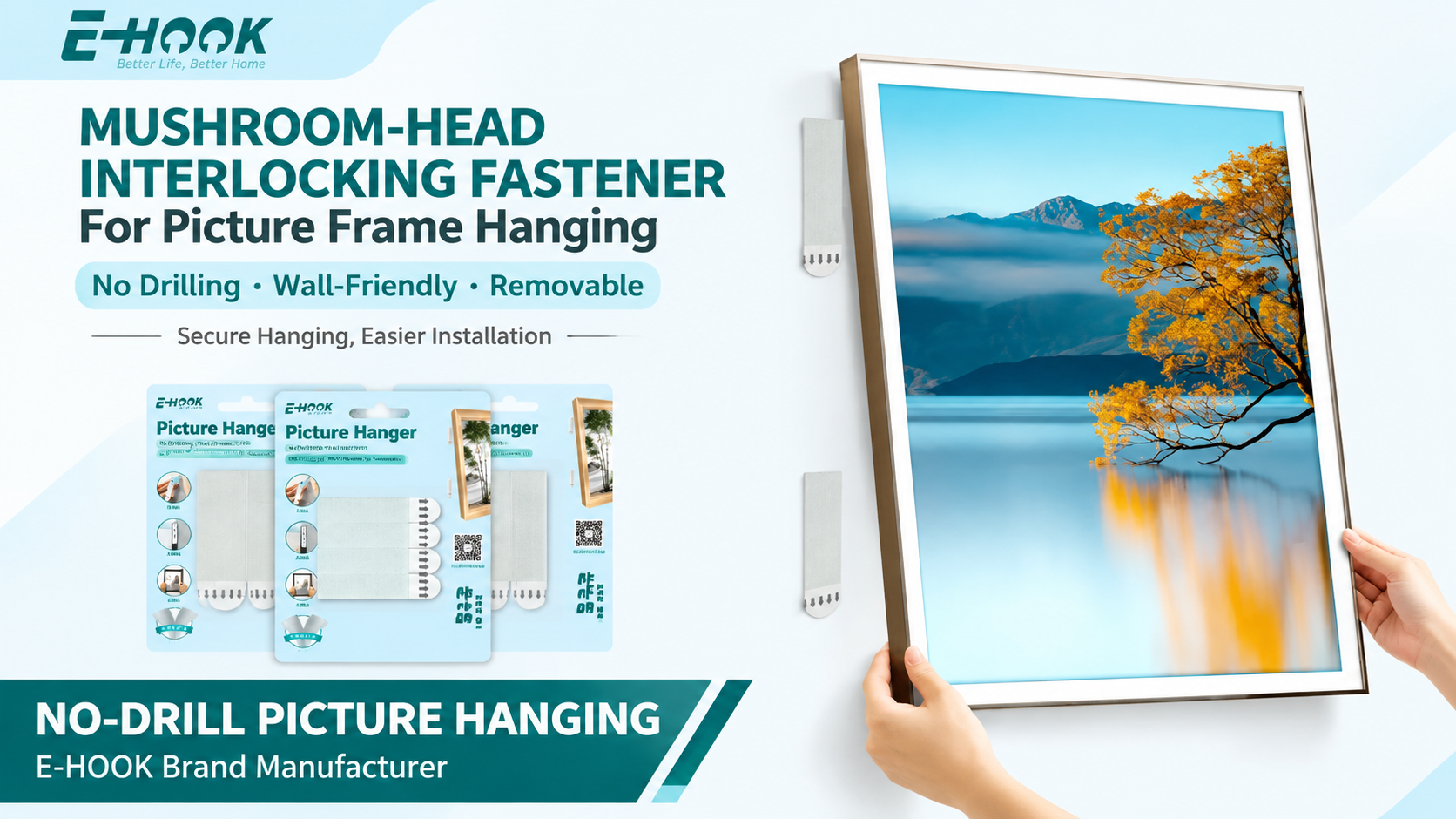
E-HOOK is a product brand of Dongguan Jiehuan Electronic Technology Co., Ltd. The company's product range includes adhesive-backed hook and loop products, PUR hot-pressed hook and loop products, injection-molded hook products, and self-mating mushroom fasteners.
For R&D teams evaluating dual lock mushroom fasteners or related reclosable fastening solutions, E-HOOK can be considered as a potential supplier for product discussions, sample evaluation, and customization inquiries. The appropriate model should be selected according to the required dimensions, material properties, holding performance, mounting method, and operating environment.
Before proceeding to production, buyers should confirm the availability of technical drawings, sample lead times, applicable test reports, compliance documents, and any project-specific customization capabilities directly with the supplier.
By defining technical requirements early and validating samples under realistic conditions, engineering teams can make more informed fastening decisions and establish a clearer path from initial concept to production.
Conclusion
Selecting the right plastic self-mating mushroom fastener requires more than finding a product with a matching name. A reliable selection process starts with dimensional analysis, load requirements, material compatibility, environmental conditions, and applicable documentation.
For teams searching for dual lock fasteners, comparing actual product structures and verified specifications is especially important because similar search terms do not guarantee equivalent designs or performance.
Use a structured parameter checklist, build a practical cross-reference table, test samples under realistic conditions, and communicate customization requirements clearly with suppliers. These steps can help reduce unnecessary trial and error, improve technical decision-making, and support a more efficient R&D process.