
Self-Mating Mushroom Fastener 2026 R&D Selection & Full Parameter Checklist
Oct 28, 2026
Plastic Self-Mating Mushroom Fasteners: A Complete 2026 R&D Selection Guide and Model Parameter Checklist
Introduction
Selecting the right plastic self-mating mushroom fastener is an important step in product development. For R&D engineers, mechanical designers, and procurement specialists, the challenge is not simply finding a fastener that fits the design. It is identifying a solution that meets dimensional requirements, delivers the required separation force, withstands the intended operating environment, and remains consistent throughout mass production.
Comparing supplier catalogs without a standardized evaluation process can lead to repeated sample testing, unexpected compatibility issues, and costly design revisions. This guide introduces a practical three-step selection framework, a material-to-working-condition reference matrix, and a model parameter checklist to help engineering teams evaluate mushroom-head interlocking fasteners more efficiently.
The guide also introduces the E-HOOK product range from Dongguan Jiehuan Electronic Technology Co., Ltd., a manufacturer specializing in fastening solutions and customized product development. Whether you are developing consumer electronics, automotive interior components, industrial enclosures, or other products requiring a reusable fastening connection, a structured selection process can help you identify suitable candidates before committing to tooling or large-scale production.
One important distinction: plastic self-mating mushroom fasteners connect through interlocking mushroom-shaped heads on compatible mating surfaces. They are different from conventional hook-and-loop fasteners, which use hooks on one side and loops on the other. Although the term dual lock is sometimes used in searches for reclosable interlocking fasteners, compatibility should never be assumed based on terminology or appearance alone. Always verify the actual product structure and test mating samples before specifying a replacement.
1. Understanding Plastic Self-Mating Mushroom Fasteners
1.1 How the Interlocking Mechanism Works
Plastic self-mating mushroom fasteners use molded mushroom-shaped projections to create a mechanical connection. When two compatible surfaces are pressed together, the mushroom heads engage with one another, forming a releasable fastening interface.
Unlike conventional hook-and-loop systems, this design does not rely on a separate soft loop surface. Depending on the product geometry, material, and engagement density, mushroom-head interlocking fasteners can provide a compact connection suitable for repeated assembly and disassembly.
When evaluating a fastener for a new product, engineers should consider more than its nominal dimensions. Important factors include:
- Mushroom-head geometry and engagement density
- Backing or mounting structure
- Engagement and separation force
- Resistance to repeated opening and closing
- Temperature, moisture, UV exposure, and chemical compatibility
- Manufacturing tolerances and consistency between batches
The right combination of these factors determines whether a fastener is suitable for a particular application.
1.2 E-HOOK Manufacturing and Product Development
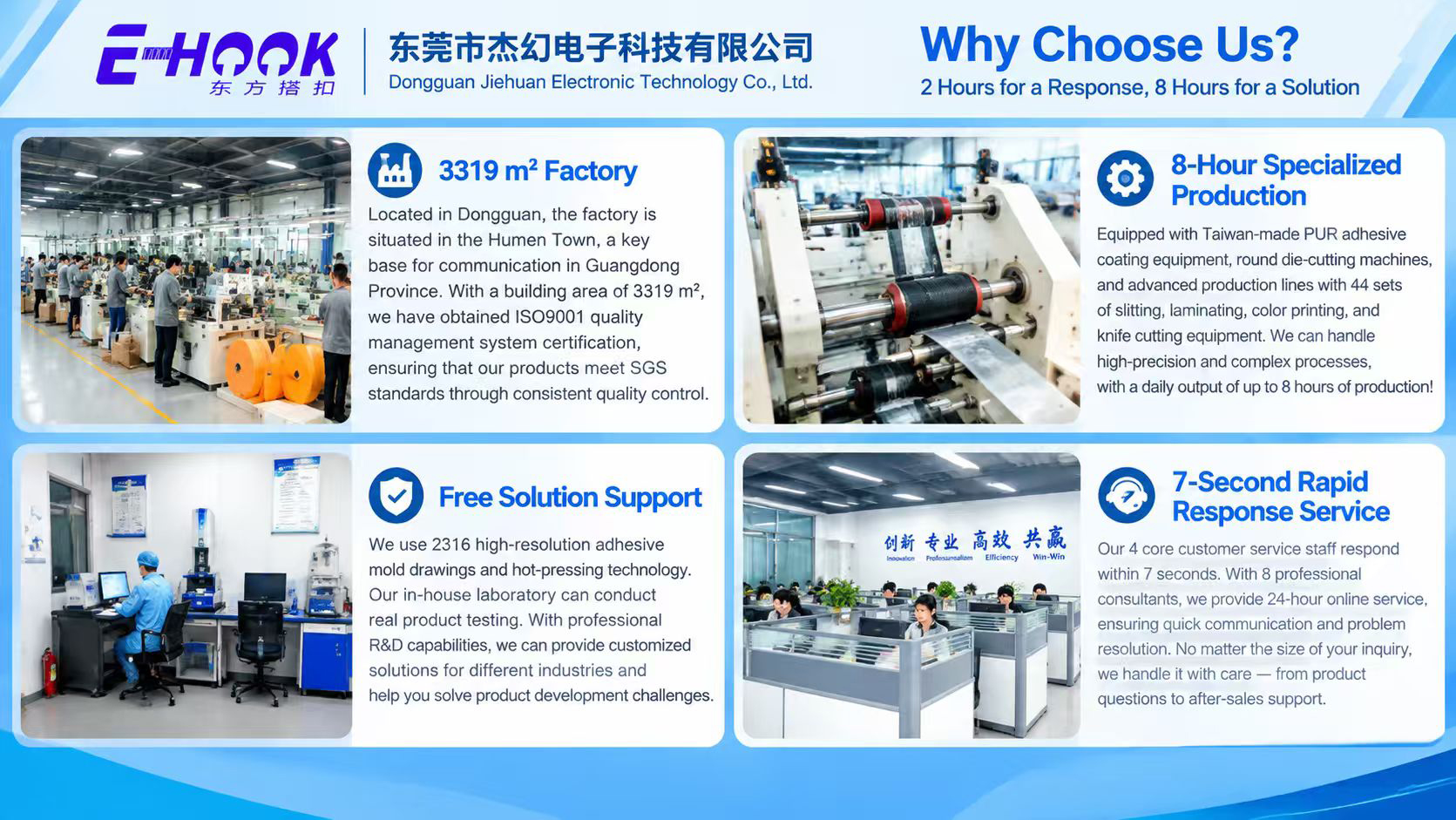
E-HOOK is a fastening product brand of Dongguan Jiehuan Electronic Technology Co., Ltd. Its product portfolio includes mushroom-head interlocking fasteners and other fastening solutions for different application requirements.
For OEM and ODM projects, the evaluation process may involve reviewing the intended application, confirming the mounting dimensions, selecting a suitable material, testing connection performance, and adjusting product specifications where necessary.
For engineering teams comparing different mushroom fastener suppliers, the most useful information is specific and verifiable: current product drawings, material specifications, tolerance requirements, test reports, and sample performance under representative operating conditions.
A manufacturer that can support these evaluations can help reduce uncertainty during product development and make the transition from prototype testing to mass production more manageable.
2. Material Options and Performance Evaluation
Material selection should be based on the actual fastener design and operating environment rather than resin properties alone. Nylon (PA66), POM (acetal), and PP (polypropylene) are possible engineering considerations, but their suitability depends on the specific grade, molding process, geometry, and required mechanical performance.
| Material | Potential Advantages | Key Considerations | Possible Applications |
|---|---|---|---|
| Nylon (PA66) | Good mechanical strength and toughness in suitable grades | Moisture absorption can affect dimensions and mechanical properties; temperature limits depend on grade and load | Mechanical components, equipment housings, selected automotive interiors |
| POM (Acetal) | Good dimensional stability, stiffness, and wear resistance in suitable grades | Chemical compatibility, temperature, and long-term stress must be evaluated | Precision components, moving assemblies, industrial equipment |
| PP (Polypropylene) | Low density and good resistance to many acids and alkalis | Lower stiffness than some engineering plastics; heat resistance and creep require evaluation | Cost-sensitive components, packaging-related applications, selected chemical environments |
The table is a preliminary material-screening reference, not a substitute for grade-specific technical data or finished-part testing.
2.1 Verify Operating Temperature and Cycle Life
Operating temperature and cycle life are two frequently requested parameters in fastener selection. However, neither should be treated as a universal value for an entire polymer family.
The maximum usable temperature depends on the material grade, applied load, exposure duration, part geometry, and dimensional requirements. Similarly, the number of opening and closing cycles depends on mushroom-head geometry, engagement force, separation method, contamination, and test conditions.
Before approving a candidate fastener, request the following information from the supplier:
- The recommended continuous and short-term operating temperatures.
- The test method used to evaluate engagement and separation force.
- The cycle-life test conditions and failure criteria.
- Any changes in performance after temperature, humidity, or chemical exposure.
- The applicable technical data sheet and test report for the actual finished product.
For applications requiring high reliability, test production-grade parts under conditions representative of the intended product rather than relying solely on raw-material data.
3. A Three-Step R&D Selection Framework
Step 1: Match Dimensions and Mounting Requirements
Begin by reviewing the mechanical drawing and identifying the dimensions that determine whether the fastener can be installed correctly.
Check the following:
- Mounting dimensions: Confirm the hole diameter, mounting-post dimensions, or adhesive-bonding area, depending on the selected design.
- Panel thickness: Ensure that the mounting structure is compatible with the full panel thickness and does not interfere with nearby components.
- Available installation space: Check clearance, access for assembly, and the space needed to separate the connected parts.
- Tolerance stack-up: Evaluate dimensional variation in both the fastener and the mating components.
Do not assume that all mushroom-head fasteners use the same mounting-hole sizes or standard tolerances. Confirm the actual dimensions in the supplier's current drawing.
For adhesive-backed configurations, evaluate the adhesive as a separate part of the fastening system. Surface energy, cleanliness, roughness, temperature, loading direction, and aging can all affect bond performance. A particular adhesive tape should only be specified after its compatibility with the fastener backing and application surface has been confirmed.
Step 2: Define Required Connection Performance
The appropriate fastener is not necessarily the one with the highest separation force. The connection must remain secure during use while still allowing the intended user or maintenance team to open it when required.
Define the required performance according to the application's actual loading conditions:
- Separation force: The force required to disengage the connected surfaces under a specified test method.
- Shear resistance: The ability of the connection to resist forces acting parallel to the bonded or engaged surfaces.
- Repeated-use performance: The extent to which the connection retains its required performance after repeated engagement and separation.
- Environmental durability: Resistance to the expected temperature, moisture, UV exposure, chemicals, dust, and other operating conditions.
- Safety margin: Additional performance allowance for manufacturing variation, aging, and foreseeable service loads.
For example, a consumer product that needs frequent manual opening may prioritize ease of separation, whereas an industrial enclosure may require stronger retention under vibration. The correct balance depends on the product's design and risk assessment.
When comparing test results, ensure that the samples, engagement procedure, separation direction, loading rate, and measurement method are comparable. A pull-force figure without its test conditions may not be meaningful for design approval.
Step 3: Validate Material Compatibility and Supply Continuity
After identifying two or three candidate models, evaluate their suitability under the intended working conditions and confirm whether the supply chain can support the project throughout its lifecycle.
| Working Condition | Evaluation Priorities |
|---|---|
| Long-term outdoor exposure | UV resistance, moisture, temperature cycling, and weathering |
| Automotive interior | Temperature variation, vibration, aging, and applicable industry requirements |
| Industrial vibration | Retention under vibration, fatigue, and repeated-use performance |
| Weak acidic or alkaline exposure | Chemical compatibility of the actual material grade |
| Cost-sensitive consumer products | Required performance, manufacturing consistency, and total installed cost |
This matrix is intended for preliminary screening. Final material selection should be based on the actual polymer grade, product construction, exposure conditions, and validation results.
For supply-chain continuity, request a controlled product drawing, material specification, model identification, and documented acceptance criteria. If a second supplier is being considered, do not assume that products with similar dimensions or marketing descriptions will interlock successfully.
A practical interchangeability assessment should include:
- Comparing dimensional drawings and critical tolerances.
- Testing sample pairs from both suppliers.
- Measuring engagement and separation performance.
- Repeating the test after relevant environmental conditioning.
- Recording results and defining acceptance criteria before mass production.
Even when two products appear similar, their mushroom-head geometry and engagement characteristics may differ. Physical validation is therefore essential before replacing an approved fastener or mixing parts from different suppliers.
4. E-HOOK Model Parameter Checklist
A model parameter checklist helps engineering and procurement teams compare candidate fasteners using a consistent set of criteria.
The following table preserves the model identifiers and preliminary parameters supplied for this guide. These figures should be treated as provisional selection references, not as independently verified E-HOOK specifications. Confirm the current product drawings, mounting dimensions, force-test conditions, materials, and compliance documents with the manufacturer before incorporating any value into a design specification.
| Model ID | Nominal Mounting Dimension | Panel Thickness Reference | Stated Pull-Force Range | Listed Material | Potential Application |
|---|---|---|---|---|---|
| EH-SM-03 | 3.0 mm ± 0.1 mm | 1.0–2.5 mm | 6–12 N | PP | Small consumer electronics and accessories |
| EH-SM-04 | 4.0 mm ± 0.1 mm | 1.5–3.0 mm | 10–18 N | Nylon | Wearable accessories and smart-home devices |
| EH-SM-05 | 5.0 mm ± 0.15 mm | 2.0–4.0 mm | 18–30 N | Nylon | Furniture assemblies and office equipment |
| EH-SM-06 | 6.0 mm ± 0.15 mm | 2.5–5.0 mm | 25–45 N | POM | Industrial panels and automotive interiors |
| EH-SM-08 | 8.0 mm ± 0.2 mm | 3.0–6.0 mm | 40–65 N | POM | Equipment enclosures and selected outdoor equipment |
| EH-SM-10 | 10.0 mm ± 0.2 mm | 4.0–8.0 mm | 60–85 N | Modified nylon | Large equipment panels and selected transit interiors |
Parameter note: Confirm whether the listed mounting dimensions refer to a hole diameter, mounting post, or another feature. Confirm the test method and loading direction for every force value. Panel-thickness suitability depends on the actual mounting design.
What to Confirm Before Ordering Samples
Before requesting samples, prepare a short technical brief covering:
- Product application and expected service life
- Mounting dimensions and available installation space
- Required separation and shear performance
- Operating temperature and environmental exposure
- Expected opening and closing frequency
- Material and regulatory requirements
- Forecast order quantity and production schedule
- Required drawings, test reports, and sample acceptance criteria
Providing this information at the beginning helps the supplier recommend relevant candidates and reduces unnecessary sample iterations.
For customized E-HOOK projects, discuss whether the existing product range can meet the design requirements or whether changes to dimensions, materials, or mounting configurations need to be evaluated.
5. Compliance, Quality Control, and Documentation
Fastener selection involves more than mechanical performance. Depending on the destination market and application, the finished product may also need to meet specific chemical, environmental, automotive, or other industry requirements.
When evaluating a supplier, ask for documentation that matches the actual product and manufacturing entity. Relevant records may include:
- Current material specifications and product drawings
- Applicable third-party test reports
- RoHS and REACH documentation, where relevant
- Quality management system certificates, if applicable
- Lot identification and traceability procedures
- Inspection criteria and nonconformance handling procedures
Do not treat a supplier's general certification statement as proof that every product or model has been tested or certified. Confirm the scope, issuing organization, validity, and product coverage of each document.
For E-HOOK, engineering and procurement teams should request the documentation applicable to the specific fastener model and intended market. This makes it easier to assess compliance requirements before tooling approval or mass production.
6. Frequently Asked Questions
Q1. Can plastic self-mating mushroom fasteners be used in automotive interiors?
Potentially, yes. Suitability depends on the material grade, fastening geometry, temperature exposure, vibration, aging requirements, and applicable automotive specifications. The complete fastening assembly should be tested under representative conditions before approval. Adhesive-backed configurations require separate evaluation of the adhesive, mounting surface, and bonding process.
Q2. What is the maximum service temperature of a PP mushroom fastener?
There is no single maximum service temperature that applies to every PP fastener. The appropriate limit depends on the specific material grade, loading conditions, exposure duration, and product geometry. Request the manufacturer's technical data and validate the finished part under the intended operating conditions. For higher-temperature applications, compare alternative materials using verified performance data.
Q3. Can I replace a fastener from one supplier with a similar model from another supplier?
Not without verification. Similar dimensions do not guarantee compatible mushroom-head geometry or equivalent engagement performance. Compare the technical drawings, test physical sample pairs, and measure connection performance using an agreed test method. If the parts will be used in a safety-critical or high-reliability application, complete the required qualification testing before approving the replacement.
Q4. What is the difference between mushroom-head interlocking fasteners and conventional hook-and-loop fasteners?
Conventional hook-and-loop fasteners use hooks on one surface and loops on the other. Self-mating mushroom-head fasteners use compatible mushroom-shaped projections on both mating surfaces. The two systems have different engagement mechanisms and should not be assumed to be interchangeable.
When researching terms such as dual lock, reclosable fasteners, or mushroom-head interlocking fasteners, check the product construction, technical specifications, and compatibility requirements rather than relying on search keywords alone.
Q5. What information should I provide when requesting a customized E-HOOK fastener?
Provide the application, mounting dimensions, operating environment, required connection performance, expected service life, target quantity, and any applicable compliance requirements. If available, include a drawing, reference sample, or assembly layout. This information helps the E-HOOK team assess whether a standard model is suitable or whether a customized solution should be considered.
Conclusion
Choosing the right plastic self-mating mushroom fastener requires a systematic evaluation of dimensions, connection performance, material compatibility, and supply-chain consistency. By following a three-step process—matching mounting requirements, validating performance under actual working conditions, and verifying interchangeability before replacement—R&D and procurement teams can make more informed decisions and reduce avoidable development risks.
A reliable selection process should be supported by current technical drawings, clearly defined test methods, representative sample testing, and product-specific compliance documentation. These measures are more useful than relying on generic performance claims or assuming that similar-looking fasteners will perform identically.
E-HOOK, a fastening product brand of Dongguan Jiehuan Electronic Technology Co., Ltd., provides a starting point for teams evaluating mushroom-head interlocking fasteners and customized fastening solutions. If your project has specific dimensional, material, or performance requirements, contact the manufacturer to discuss available models, sample evaluation, and customization possibilities.
The best fastener is not simply the one with the highest stated performance. It is the one whose verified specifications match your design, operating environment, and production requirements.